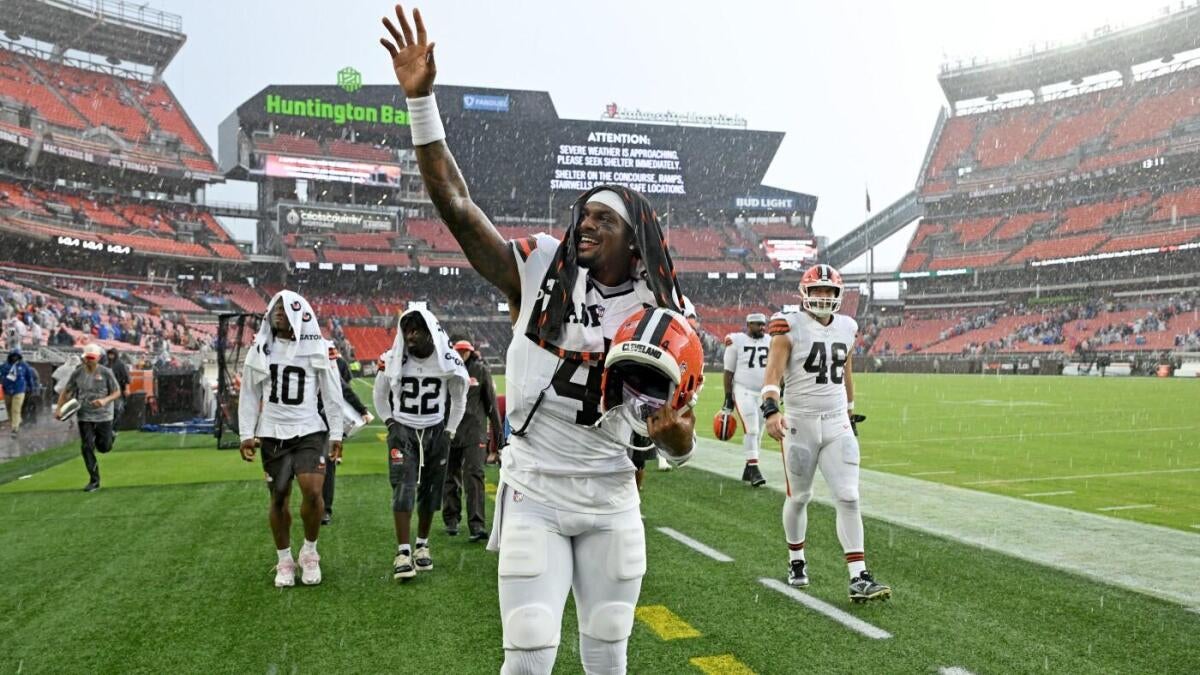
While Deshaun Watson is Cleveland's starting QB, a critical contract clause mandates his release by March 2027, avoiding a monumental $200 million guaranteed payment.
The Cleveland Browns have officially named Deshaun Watson as their starting quarterback, a decision that comes with a significant and unusual long-term implication for the team's future. Despite Watson taking the top spot on the depth chart, a specific clause in his contract practically guarantees his departure from the franchise after the 2026 NFL season.
This peculiar contractual arrangement means the Browns will almost certainly release Watson in March 2027 to prevent a massive financial obligation, adding a bizarre layer to their choice of starting quarterback. The situation creates an environment where Watson's future in Cleveland is predetermined, regardless of his on-field performance.
The move to cut Watson by the specified deadline would save the Browns a staggering sum, but not without absorbing a substantial cap hit of their own, according to reporting by CBS Sports - NFL.
The $200 Million Contract Clause Affecting Deshaun Watson's Future
The primary reason Deshaun Watson's tenure with the Cleveland Browns is set to conclude after the 2026 season revolves around a specific contract restructure implemented in December 2024. After acquiring Watson in 2022, the Browns initially signed him to a fully guaranteed five-year, $230 million deal, a transaction many consider one of the NFL's most challenging trades and contracts.
Over the past four years, Cleveland has repeatedly restructured Watson's contract to manage salary cap hits, pushing significant financial burdens further into the future. However, a crucial "poison pill" clause was embedded during the December 2024 rework, as detailed by former NFL agent Joel Corry. This clause effectively mandates Watson's release by March 13, 2027.
The mechanism is clear: Watson's contract includes a base salary of $200 million in 2029, which is currently not guaranteed. However, this entire sum becomes fully guaranteed if he remains on the Browns' roster by the third day of the league year in 2027. To avoid paying this monumental $200 million, the team must release Watson before the March 13, 2027, deadline. By that time, Watson will have received his full $230 million guaranteed from the original deal.
The Massive Dead Cap Hit for the Cleveland Browns
While releasing Deshaun Watson will prevent the Cleveland Browns from incurring the additional $200 million payment, it comes at a significant cost in the form of a massive dead cap hit. The Browns are projected to absorb an $86.2 million dead cap charge, which would rank as the second-largest in NFL history, reflecting the steep financial consequences of the initial trade and contract.
This figure is only surpassed by the record $99.2 million dead cap hit the Miami Dolphins incurred when they released Tua Tagovailoa a few months prior. Similar to the Dolphins' approach, Cleveland is expected to designate Watson as a post-June 1 release. This strategic move allows the team to spread the financial impact of the dead cap over two seasons, mitigating its immediate effect.
Under a post-June 1 designation, the dead cap will be split: $34.7 million in 2027 and $51.5 million in 2028. This structure means the financial repercussions of the Deshaun Watson trade will continue to impact the Browns' salary cap through the 2028 season, delaying their full ability to move past the costly acquisition.
Analyzing Deshaun Watson's Costly Tenure in Cleveland
The decision to acquire Deshaun Watson has proven to be an immensely expensive and largely disappointing chapter for the Cleveland Browns. Through four seasons since his arrival, Watson has started only 19 games, recording a 9-10 win-loss record. During this period, he has earned a total of $184 million from his contract.
This translates to an astonishing cost of approximately $20.4 million per victory for the franchise. The Browns are set to pay Watson an additional $46 million in 2026, which is widely anticipated to be his final payment from the team. The impending release highlights the substantial investment versus the limited on-field return.
The current situation, where Watson is named the starting quarterback despite his contract ensuring a short-term future, suggests a peculiar dilemma for Cleveland. As the source indicates, whether Watson performs exceptionally well or struggles, his future with the team beyond 2026 remains unchanged due to the prohibitive financial structure, raising questions about alternative options like starting Shedeur Sanders.
Frequently Asked Questions
Why will the Cleveland Browns cut Deshaun Watson after the 2026 season?
The Cleveland Browns will almost certainly release Deshaun Watson by March 13, 2027, to avoid guaranteeing a $200 million base salary for the 2029 season. A specific contract clause makes this sum fully guaranteed if he remains on the roster past that deadline.
What is an NFL dead cap hit?
An NFL dead cap hit refers to salary cap money that a team has already paid or committed to a player but must account for on their salary cap even after the player is no longer on the active roster. This typically occurs when guaranteed money, like signing bonuses, has been paid upfront but not yet amortized against the cap over the life of the contract.
How much dead cap will the Browns incur by releasing Deshaun Watson?
By releasing Deshaun Watson, the Cleveland Browns will incur a massive $86.2 million dead cap hit. They are expected to use a post-June 1 designation to split this cost over two seasons: $34.7 million in 2027 and $51.5 million in 2028.
When is the deadline for the Browns to cut Deshaun Watson?
The Cleveland Browns face a critical deadline of March 13, 2027, to release Deshaun Watson. Failing to do so would trigger the full guarantee of his $200 million base salary for the 2029 season, which the team aims to avoid.
What was Deshaun Watson's record and earnings with the Browns?
Through four seasons with the Cleveland Browns, Deshaun Watson has started 19 games, achieving a 9-10 win-loss record. During this period, he has earned approximately $184 million from his fully guaranteed contract.