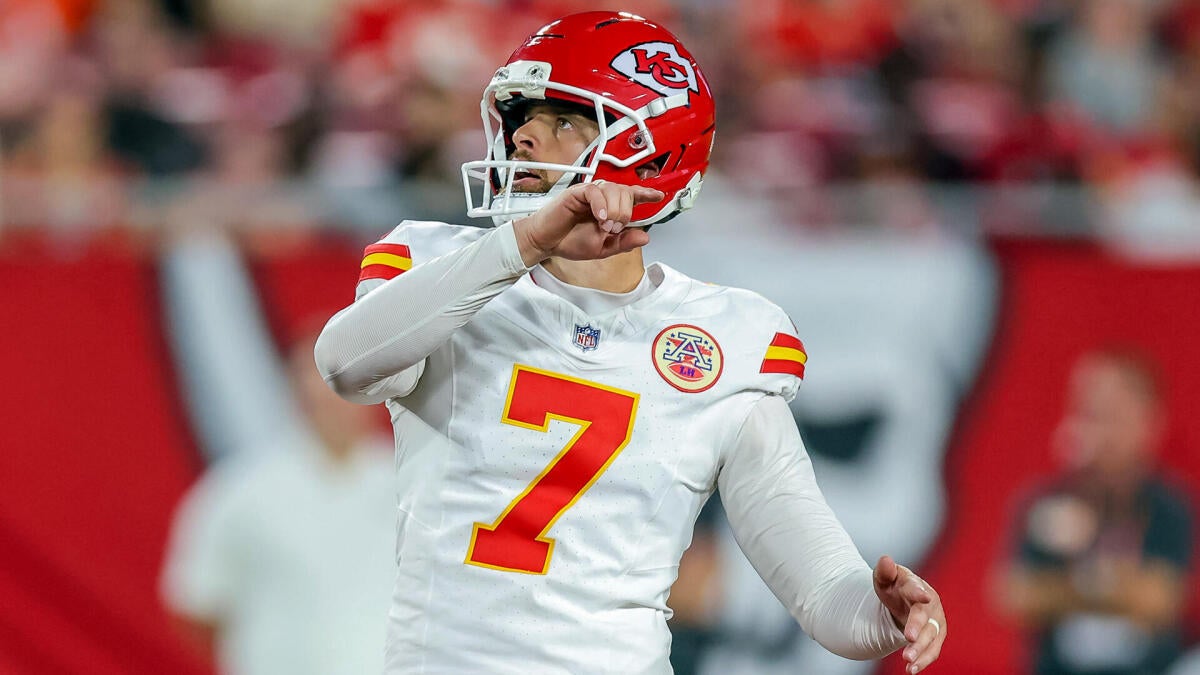
Butker's monstrous kick against the Buccaneers topped the official league record by a yard, but NFL preseason rules prevent it from counting.
Kansas City Chiefs kicker Harrison Butker delivered one of the most talked-about plays of the NFL preseason on Saturday night, drilling an astonishing 69-yard field goal just before halftime in the game against the Tampa Bay Buccaneers. The kick was a spectacle, easily clearing the crossbar and soaring deep into the net behind the uprights, demonstrating incredible power and accuracy.
While the monumental effort exceeded the current NFL record for the longest field goal by a full yard, it will not be officially recognized in the league's record book. This is due to a long-standing rule that dictates only kicks made during regular season or playoff games count towards official NFL records, rendering preseason accomplishments unofficial.
Despite this technicality, Butker's 69-yard field goal remains an extraordinary athletic achievement, ranking among the longest kicks ever recorded in any football game. It sparks questions about the boundaries of kicking prowess and the future of NFL records, according to reporting by CBS Sports - Headlines.
Analyzing Harrison Butker's Historic Preseason Field Goal
The opportunity for Butker's record-setting attempt arose from a defensive stand late in the first half. With under ten seconds remaining in the second quarter, the Buccaneers faced a fourth-and-5 situation from the Chiefs' 49-yard line. Tampa Bay opted to go for the first down, but a crucial incomplete pass from quarterback Jake Browning gave Kansas City possession with only three seconds left on the clock.
Chiefs head coach Andy Reid then made the decision to send out Harrison Butker for the improbable attempt. Butker not only made the 69-yard field goal but absolutely "smashed" it, as described in initial reports. The ball traveled with such force that experts suggest it likely would have been good from an even greater distance, possibly 75 yards or more, highlighting the kicker's immense leg strength.
This incredible kick was one of three successful field goals Butker made against Tampa Bay that night, also including a 58-yarder and a 45-yarder. However, he also missed a 43-yard attempt in the fourth quarter of Kansas City's narrow 16-15 loss, showcasing the variability inherent in kicking at extreme distances.
Why Preseason Kicks Don't Count Towards Official NFL Records
The NFL record book strictly distinguishes between preseason performances and those during the regular season or playoffs. This rule means that while Harrison Butker's 69-yard field goal surpassed the current official NFL record, it does not officially replace it. As a result, Cam Little's 68-yard field goal from a recent regular season game still stands as the longest kick in NFL history.
Butker's preseason heroics, however, do earn him significant bragging rights within the broader context of football history. His 69-yarder is tied for the second-longest field goal ever made in an actual game, spanning 157 years since the first American football game in 1869. Only three kickers have achieved a field goal of at least 69 yards in a game.
Cam Little notably hit a 70-yard field goal for the Jaguars during the 2025 preseason, which also did not count officially. Before the modern era, Abilene Christian kicker Ove Johansson made a 69-yarder in 1976. It's worth noting that college kickers like Johansson were permitted to use a 1- to 2-inch kicking block until its ban in 1989, effectively kicking off a tee. In contrast, Little and Butker achieved their immense kicks off the ground, placing them in a unique category of modern kicking prowess.
The NFL's K-Ball Rule: Boosting Long-Distance Field Goals
The recent surge in exceptionally long field goals, including Butker's prodigious kick, can be partly attributed to a significant change in NFL rules regarding footballs. Starting last season, the league implemented a new "K-ball" rule designed to give kickers better equipment. Teams now receive 60 kicking footballs at the start of the season, allowing them to properly break them in during practice.
This new rule contrasts sharply with the previous system, which was in place from 1999 until the 2024 season. Under the old rule, teams received only three brand-new, stiff footballs on game day, with roughly an hour to prepare them. A broken-in football, which can also be brushed to smooth out its tiny bumps, tends to fly better and allows for superior contact, translating to longer, more accurate kicks.
Many NFL kickers have observed a tangible impact from the new K-ball rule, suggesting it adds an extra five to ten yards to their kicking distance. Darrin Simmons, the Bengals' special teams coordinator who has been an NFL assistant since 1998, believes this rule change will continue to push the boundaries of kicking records. "I believe it makes a big difference and I think that's why the distances on some of these long field goals went up and I think it will continue to just skyrocket as long as that rule stays in place the way it is," Simmons told CBS Sports and other outlets in late July.
With Harrison Butker now having demonstrated his capacity for a 69-yard field goal, and given the impact of the K-ball rule, observers anticipate that the official NFL record for longest field goal could be broken again soon. Cam Little himself broke the previous record with a 68-yarder last November, having also hit a 67-yarder in Week 18, setting new benchmarks for outdoor and overall longest kicks.
Frequently Asked Questions
Is Harrison Butker's 69-yard field goal an NFL record?
No, Harrison Butker's 69-yard field goal, though historic in length, was made during the NFL preseason and therefore does not officially count towards league records. Only kicks from regular season or playoff games are eligible for official NFL records.
Who holds the official NFL record for the longest field goal?
The official NFL record for the longest field goal is held by Cam Little, who drilled a 68-yard field goal in November of last season. He also holds the record for the longest outdoor field goal with a 67-yard kick.
What is the NFL's K-ball rule and how does it affect field goals?
The NFL's K-ball rule, implemented last season, provides teams with 60 kicking footballs at the start of the season to break in during practice. This process softens the balls and allows kickers to make better contact, leading to increased distances of five to ten yards on field goals, according to many players and coaches.
How does Harrison Butker's 69-yard kick compare to others in football history?
Harrison Butker's 69-yard field goal is tied for the second-longest field goal ever made in any football game. Cam Little made a 70-yarder in a preseason game, and Ove Johansson made a 69-yarder in college in 1976, though Johansson's kick was made when kicking blocks were permitted.