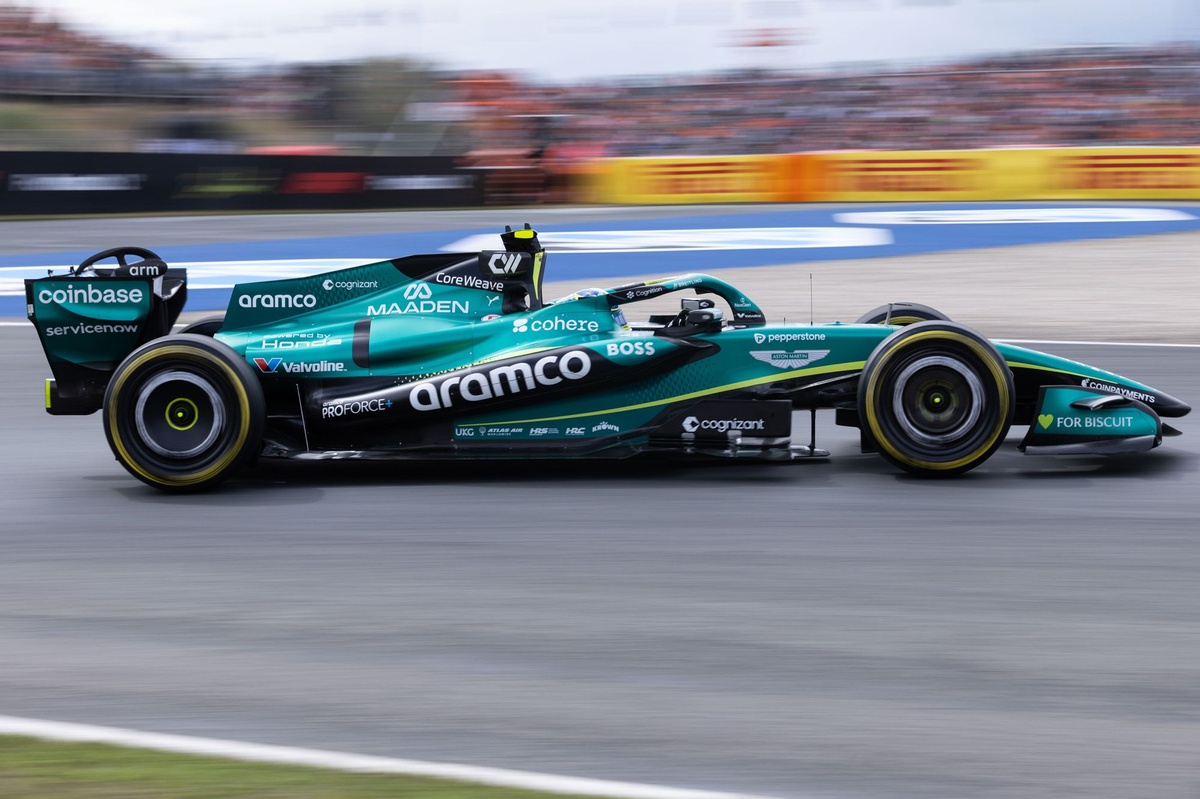
Aston Martin driver Fernando Alonso struggled with car control at Zandvoort after receiving Honda's upgraded V6 power unit.
Aston Martin's Fernando Alonso faced unexpected challenges with the handling of his car during sprint qualifying at the Zandvoort circuit. The two-time Formula 1 world champion openly stated that he struggled to maintain control, indicating a clear need for further development to fully harness the potential of a significant engine upgrade.
These driveability issues emerged immediately after Aston Martin debuted Honda's second-specification V6 power unit. Both Alonso and his teammate, Lance Stroll, received this upgraded engine, which the Japanese manufacturer had strategically planned to deploy at the Netherlands Grand Prix.
The new power unit promises enhanced performance, but its integration has presented early obstacles regarding car optimization and control for the Aston Martin team, according to reporting by Autosport - F1.
Alonso's Zandvoort Struggle with Honda's New Power Unit
During the intense sprint qualifying session at Zandvoort, Fernando Alonso described a noticeable difficulty in keeping his Aston Martin AMR23 on the track. This struggle points directly to the immediate impact of the newly introduced Honda F1 engine, suggesting that while the unit offers more power, it has introduced complexities in how that power is delivered and managed by the car's chassis and setup.
The upgraded V6 power unit from Honda was a highly anticipated in-season improvement, marking a crucial step in the manufacturer's development plan for the year. However, the initial experience suggests that raw power gains must be carefully balanced with the nuanced requirements of F1 car control, especially on demanding circuits like Zandvoort.
Optimizing the Upgraded Honda V6 Engine for Better Driveability
Fernando Alonso emphasized that “more work is needed to optimise” Honda's more powerful engine. This optimization process involves a complex interplay between the engine's power delivery, the car's aerodynamics, suspension settings, and electronic systems. Achieving seamless integration is crucial to translate increased horsepower into faster, more controllable lap times.
The challenge for Aston Martin and Honda now lies in fine-tuning the engine's settings and the car's configuration to mitigate these initial driveability issues. This ongoing development will be key to unlocking the full performance potential of the new power unit and ensuring both Fernando Alonso and Lance Stroll can confidently push their cars to the limit without compromising control.
Frequently Asked Questions
What is the new Honda F1 engine specification that caused driveability issues?
The new unit is the second specification of Honda's V6 power unit, deployed by the Japanese manufacturer specifically at the Netherlands Grand Prix for Aston Martin drivers Fernando Alonso and Lance Stroll.
Why did Fernando Alonso struggle with driveability at Zandvoort?
Fernando Alonso struggled to keep his Aston Martin on track during sprint qualifying because the more powerful new Honda engine requires further optimization to balance its increased output with the car's overall handling and setup.
What does "optimise" mean in the context of an F1 engine and car?
To "optimise" an F1 engine and car means fine-tuning various settings, including power delivery maps, chassis setup, and aerodynamics, to ensure the engine's full power can be effectively and controllably used by the driver for maximum performance on track.