Drivers found the high-speed street circuit unforgiving, with significant tire degradation and limited overtaking, making qualifying crucial.
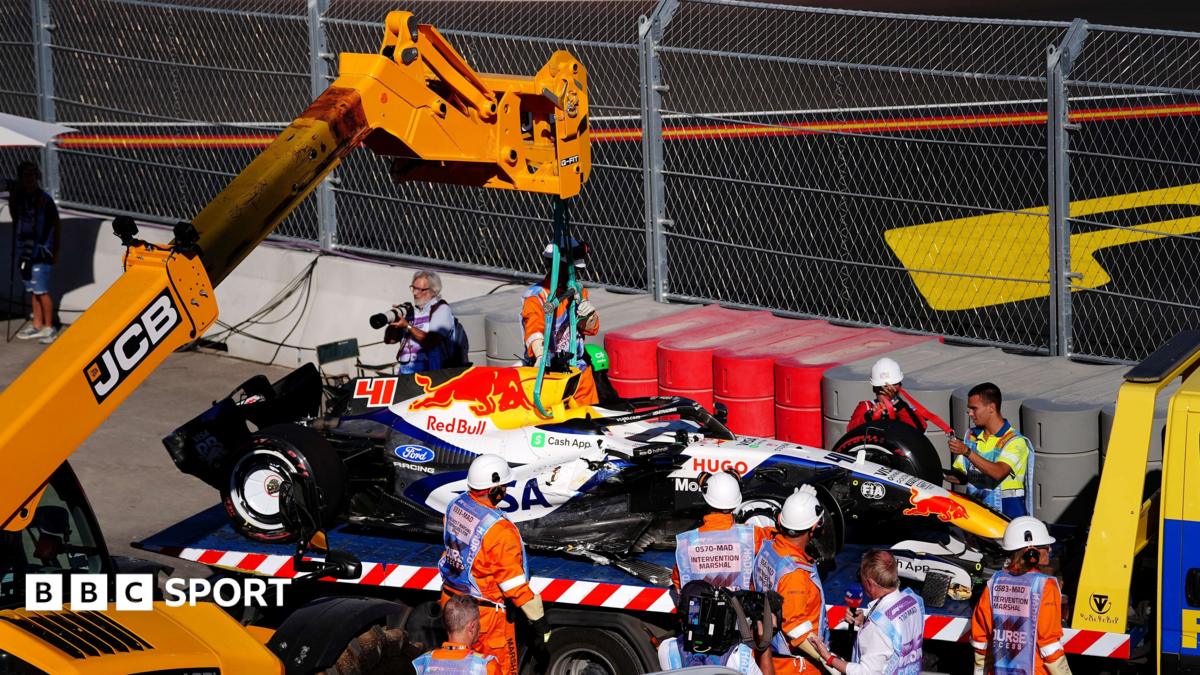
Mercedes driver George Russell has described the new Madrid Formula 1 circuit as "very high risk" following a significant incident involving British rookie Arvid Lindblad during Friday's practice session for the Spanish Grand Prix. Lindblad's crash was the sole major accident of the day, though several other drivers made contact with the walls as they pushed the limits of the unfamiliar track.
Nineteen-year-old Lindblad, driving for Racing Bulls, lost control at Turn 13, sliding sideways into a barrier. The impact caused considerable damage to his car, including both front and rear suspension components and a broken front wing. Despite the incident, the young driver impressively finished the session fourth fastest, just 0.228 seconds behind pace-setter Kimi Antonelli of Mercedes.
The general sentiment among the F1 paddock points to an exceptionally demanding street circuit. Concerns range from the track's high-speed characteristics and unforgiving barriers to significant tire degradation, all of which will present a severe test for drivers throughout the race weekend, according to reporting by BBC Sport - Formula 1.
The New Madrid Circuit: A High-Speed Challenge
Russell's assessment of the Madrid circuit as a place of "very high risk" was emphatic, suggesting that drivers were deliberately holding back a little during practice. He had previously noted the track offered "less margin than Monaco, purely because of the speed." Unlike Monaco, where slower speeds might allow for recovery from a minor mistake, the rapid pace in Madrid means a driver hitting the wall does so with greater impact and less chance to react.
Adding to the peril, Russell highlighted how some barriers are angled back towards the track. This design means that if a car goes wide and hits a wall, it doesn't strike at the same angle it's traveling, but rather the wall "is sort of coming in at you." He specifically pointed out Turns Five, Seven, and 17 as particularly challenging corners, with Ferrari's Charles Leclerc notably going off into the run-off area at Turn 17.
Tire Degradation and Overtaking Concerns
Another major concern for teams is tire degradation on the new track surface. Russell reported that grip levels are very high, but this leads to aggressive sliding, which rapidly wears down the tires. He starkly stated that based on the degradation seen in the first practice session, "a six-stop race would be the fastest way." While the second practice session showed slight improvement, tire management remains a significant question mark for the race.
Leclerc, who was second fastest in practice, praised the track as "very exciting, very challenging," and typical of the street circuits he enjoys. However, he echoed Russell's observations about the difficulty of overtaking. Leclerc believes that qualifying will be the most critical part of the weekend, as it appeared "extremely difficult or impossible to overtake" in the second practice session, meaning grid position will largely dictate race performance.
Rookie Lindblad's Impressive Pace Amidst Incident
Despite his crash at Turn 13, which damaged his Racing Bulls car's suspension and front wing, Arvid Lindblad remained optimistic. He acknowledged pushing the limits on a new track that is challenging for everyone. "I just made a bit of mistake and overdid it a little bit," Lindblad admitted, apologizing to his mechanics for the extra work. However, he was encouraged by his underlying pace, confirming he was running P4 "on merit" and was only 0.2 seconds off the fastest time, which he considered "really strong."
Kimi Antonelli set the pace for Mercedes, followed by Charles Leclerc and Lewis Hamilton, both just over 0.1 seconds behind Antonelli. Russell secured the fifth-fastest time, ahead of Red Bull's Max Verstappen and McLaren's Oscar Piastri. Reigning world champion Lando Norris did not register a time due to a gearbox problem with his McLaren.
Safety Concerns Beyond F1 Practice
The F1 drivers' concerns about potential incidents were further underscored by a separate fiery accident during Formula 2 practice. Thai driver Tasanapol Inthraphuvasak was involved in the incident but fortunately emerged unharmed. This highlights the inherent dangers of these high-speed, tight street circuits, reinforcing Russell's predictions of many lock-ups.
Russell also drew parallels between some of Madrid's turn-and-brake sections, where walls are immediately present, to Baku's notorious Turn 15, known for catching drivers out. He also compared a section of high-speed swerves to the fast street circuit in Jeddah, Saudi Arabia, emphasizing the consistent high-intensity nature of the new Madrid track.
Frequently Asked Questions
Why is the new Madrid F1 circuit considered high risk?
The new Madrid F1 circuit is considered high risk due to its high-speed corners, proximity of unforgiving barriers, and unique wall angles that offer less margin for error compared to other street tracks like Monaco, according to driver George Russell.
Who crashed during Friday practice at the Spanish Grand Prix in Madrid?
British rookie Arvid Lindblad, driving for Racing Bulls, was the only driver to have a major accident during Friday practice at the Spanish Grand Prix in Madrid, crashing at Turn 13.
What are the main challenges drivers face on the Madrid F1 track?
Drivers face significant challenges including rapid tire degradation due to aggressive sliding, extremely difficult or impossible overtaking, and complex high-speed sections with unforgiving barriers that can lead to lock-ups and high-consequence impacts.
How did rookie Arvid Lindblad perform despite his crash?
Despite his crash that damaged his car, Arvid Lindblad showed impressive pace, finishing Friday's practice session fourth fastest overall, just 0.228 seconds behind the lead time set by Kimi Antonelli.