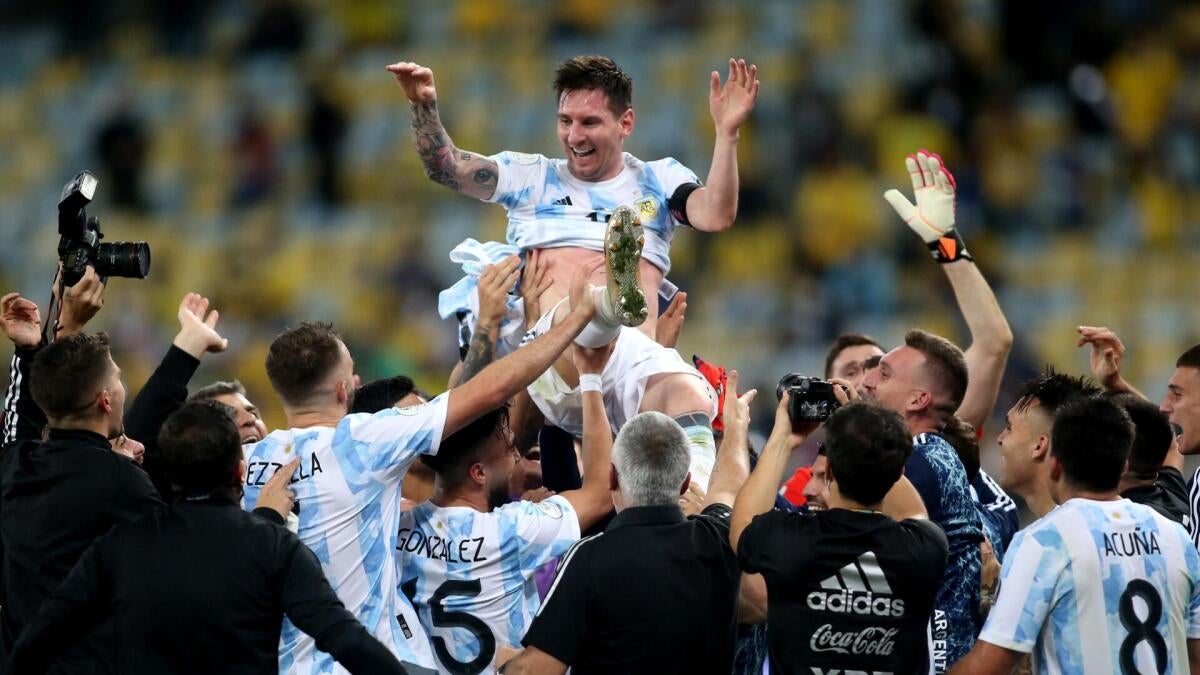
Lionel Messi's international path with Argentina spanned 21 years, marked by early struggles and heartbreaking defeats before finally securing a World Cup and two Copa America titles.
Lionel Messi's legacy with the Argentina national team is undeniably iconic, encompassing his status as the all-time appearance leader and greatest goalscorer, alongside a FIFA World Cup and two Copa America titles. These accolades fittingly honor a player of his extraordinary talent, universally adored as he concludes his international career 21 years after his debut, according to reporting by CBS Sports - Soccer.
However, Messi's journey with Argentina was remarkably intricate, a winding road to a triumphant conclusion. For the majority of his more than two decades wearing the light blue and white jersey, major international success eluded him, overshadowed by painful defeats and disappointing results. Despite his otherworldly skill with a soccer ball, he often shouldered disproportionate blame for the team's shortcomings.
This complex tenure highlighted the immense emotion, passion, and pressure intertwined with representing Argentina's storied national team. Messi himself acknowledged this challenging path in a handwritten note following last month's World Cup final, reflecting on a journey that was anything but consistently upward. He described it as a “beautiful but difficult journey,” emphasizing his unwavering commitment throughout.
Messi's Challenging Start and Early Promise with Argentina
Signs of a non-straightforward international career appeared almost immediately for Messi. His Argentina debut in a 2-1 victory against Hungary in 2005 saw him receive a red card within 90 seconds for an elbow, a call that replays suggest was notably soft. This incident, however, did not diminish his burgeoning prospects.
Messi was already a formidable talent, having led Argentina to victory in the 2005 FIFA World Youth Championship and consistently disrupted opposing defenses with memorable flair. He quickly transitioned to the senior international team, earning a spot on Argentina's roster for the 2006 World Cup in Germany, where the team reached the quarterfinals. He scored his sole goal of the tournament in a resounding 6-0 win over Serbia and Montenegro during the group stage.
His stock continued to soar over subsequent years, highlighted by winning a gold medal with the U-23 team at the 2008 Olympics in Beijing. Messi wore the No. 19 for much of this period, with his vintage Adidas kits remaining popular among fans even at the most recent World Cup. He inherited the iconic No. 10 shirt from Juan Roman Riquelme before the 2010 World Cup, a clear indication that he was now seen as Argentina's new star player.
The Weight of Expectations and Heartbreaking Finals
As Messi's role with Argentina expanded, he achieved unparalleled club success with Pep Guardiola's star-studded Barcelona, winning two UEFA Champions League titles before the 2010 World Cup and two more afterward. Yet, the contrast between his club dominance and international struggles became starkly apparent, particularly at the 2010 and 2014 World Cups.
Despite his generational talent and a fierce rivalry with Real Madrid's Cristiano Ronaldo, lifting trophies with Barcelona seemed effortless compared to his challenges with Argentina. The team exited the 2010 World Cup in the quarterfinals, where Messi failed to score a single goal under the management of national hero Diego Maradona. Similar disappointment followed at the 2011 Copa America, again with a quarterfinal exit and no goals from Messi.
This period set the stage for the most painful chapter of his international career. His World Cup goal-scoring drought ended in 2014 in Brazil, where he netted four goals en route to the final. However, Argentina agonizingly lost to Germany in extra time, marking the first of three consecutive major final defeats. The team subsequently fell in the 2015 and 2016 Copa America finals, the latter a penalty shootout loss to Chile at MetLife Stadium. After this defeat, Messi expressed profound vulnerability, stating in 2016, "I'm done playing with the national team." He felt luck would never favor him, adding, "It's been four finals, and I was not able to win. I tried everything possible. It hurts me more than anyone, but it is evident that this is not for me."
A Triumphant Turn: From Despair to Definitive Glory
Despite his temporary retirement declaration in 2016, Lionel Messi returned to the national team within weeks, driven by an unyielding desire for international success. This pivotal decision paved the way for the most glorious chapter of his Argentina career, fundamentally altering his legacy and solidifying his place in football history.
The breakthrough arrived in 2021 when Argentina, with Messi at the helm, secured the Copa America title. This victory, ending a 28-year drought for the nation, was Messi's first major international trophy. It finally alleviated years of pressure and set the stage for the ultimate triumph: the 2022 FIFA World Cup in Qatar.
Lifting the World Cup trophy marked the crowning achievement of Messi's international journey, fulfilling a lifelong dream for him and a nation. Reflecting on this arduous path, Messi wrote in his note, "I swear I always gave everything, not only in these last few years when we won everything, but before that too." He thanked his family for being with him throughout this "beautiful but difficult journey," acknowledging the coaches, teammates, and directors who shared his two decades of dedication to the Argentina shirt.
Frequently Asked Questions
When did Lionel Messi make his Argentina debut?
Lionel Messi made his senior international debut for Argentina in 2005 in a friendly match against Hungary, an occasion that famously saw him red-carded within 90 seconds of entering the game.
What major international titles did Messi win with Argentina?
Lionel Messi won three major international titles with Argentina: the 2021 Copa America, the 2022 FIFA World Cup, and earlier, the 2008 Olympics gold medal with the U-23 team, and the 2005 FIFA World Youth Championship.
Did Lionel Messi ever retire from international football?
Yes, Lionel Messi temporarily announced his retirement from the Argentina national team in 2016 after their defeat in the Copa America final, but he returned to play for the squad just weeks later.
How many World Cups did Messi play in?
Lionel Messi participated in five FIFA World Cups with Argentina: 2006, 2010, 2014, 2018, and 2022, ultimately winning the tournament in his final appearance.