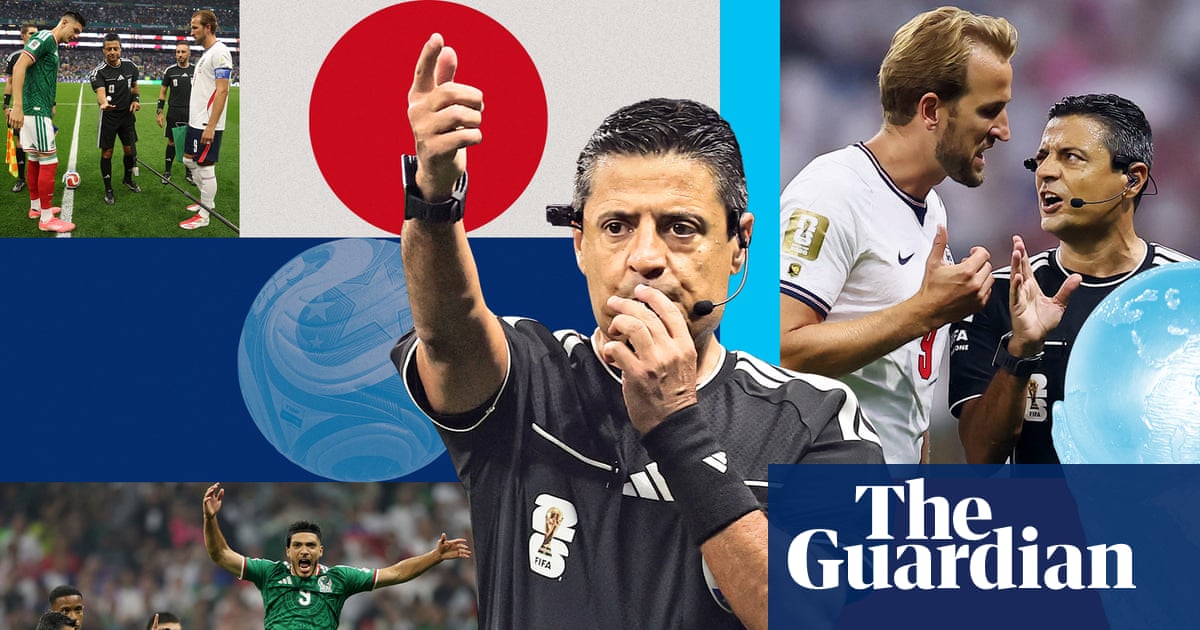
Australian-Iranian official Alireza Faghani details the chaotic atmosphere, altitude challenges, and fiery decisions in the crucial last-16 tie.
In the vibrant heart of Mexico City, amidst the thunderous roar of nearly 90,000 fans, referee Alireza Faghani found himself battling more than just player tempers during the 2026 World Cup last-16 tie between Mexico and England. The 48-year-old Australian-Iranian official was thrust into an environment where external pressures threatened to overshadow the game itself, with England manager Thomas Tuchel later describing the officiating as “just not good enough”.
Faghani, a veteran officiating his fourth World Cup, recalls being jolted awake in the locker room by the muffled sound of the Estadio Azteca crowd on July 5. The match, already delayed by an hour due to a torrential storm, presented a unique crucible of high altitude, immense fan passion, and relentless on-field intensity, pushing the referee to his limits.
His personal account offers a rare glimpse into the mental fortitude and precise decision-making required to manage such a high-stakes international fixture, especially when every element from the weather to the crowd noise conspires to disrupt focus, according to reporting by The Guardian - World Cup 2026.
Preparing for the Cauldron: Altitude and Disruption
The Estadio Azteca, perched 2,240 meters above sea level, presented a formidable challenge long before kick-off. Opponents often struggle to breathe in the thin air, a factor contributing to Mexico’s impressive record of not losing a competitive game at the venue since 2013. For Faghani, the match was a critical step towards potentially officiating the final, demanding a flawless performance.
Adding to the complexity, a severe storm had delayed the start by an hour. This uncertainty around the kick-off time significantly disrupted Faghani’s meticulous pre-match physical and nutritional schedule. “I don’t really have any superstitions, but I do like routine,” he stated, emphasizing how routine provides “a sense of calm and helps me enter the field with a clear mind.”
Despite the disruptions, Faghani maintained his professional composure, focusing on what he could control. His preparation involved extensive study of players, understanding their “triggers, their temperaments and their tendencies in different match scenarios.” He explained, “You know the key players, you understand their characteristics and how they normally behave in certain situations,” but stressed the importance of not introducing bias from his notes.
Navigating the Roar: Unbelievable Noise and Early Decisions
From the moment England kicked off to a chorus of boos, the atmosphere inside the Azteca was overwhelming. Faghani vividly remembers the sound that had initially woken him up now becoming a constant barrage: “The noise was unbelievable.” He actively tried to block out the deafening roar, aware of its potential to threaten his impartiality on borderline calls, knowing home crowds “react strongly to decisions involving their team.”
Just seconds into the game, the match exploded. England’s Declan Rice stretched for a loose ball and inadvertently caught an opponent in the head with his boot. Though wanting to keep his cards in his pocket early in the match to manage players later, Faghani felt he had no alternative. He flashed a yellow card, igniting the Mexican fans and sending a clear message to players.
Faghani firmly believed it was “a clear yellow card for me,” adding, “It also helped everyone understand the line from the beginning.” The incident immediately signaled the intense, emotional, and fast-paced nature of the game, with England manager Thomas Tuchel visibly berating the fourth official on the sideline.
Asserting Authority: Managing Dissent in a Fiery Clash
As the match progressed, frustration simmered among players, fueled by fervent tackles and the roaring crowd. Faghani found himself constantly weighing interventions, asking, “whether an intervention will help the match or interrupt it unnecessarily.” An instance of dissent arose when a Mexican defender angrily protested a foul called against him for tugging down Jude Bellingham.
In a decisive display of authority, Faghani sprinted over, stood face-to-face with the player, and blew his whistle sharply. He explained that “in that environment, I felt it was important to deal with dissent immediately.” This strong body language, he noted, was often more effective than issuing cards, sending “a clear message that communication was welcome, but there was a limit.”
The tactic proved successful, as dissent dissipated, allowing the Mexicans to settle into a period of flowing football. Faghani’s ability to manage the game’s temperature without excessive carding highlighted his experience and nuanced approach to officiating in a high-pressure environment.
Momentary Appreciation Amidst Rising Pressure
The game’s first decisive moments came from England, with two goals scored by Jude Bellingham, putting them ahead. Mexico quickly responded with a goal of their own, making the score 2-1 to England. Faghani felt the pressure intensifying, but allowed himself a brief moment to appreciate the sheer skill on display.
“You definitely appreciate the quality, but only for a second,” Faghani recounted. As a referee, his mind immediately shifted to the next responsibility, focusing on the restart, player reactions, his positioning, and maintaining unwavering concentration. As England held onto their lead until half-time, Faghani reflected with mild satisfaction on his performance, knowing the second half would bring even greater challenges.
Frequently Asked Questions
Who was the referee for Mexico v England at the 2026 World Cup?
Alireza Faghani, a 48-year-old Australian-Iranian official, refereed the last-16 match between Mexico and England at the 2026 FIFA World Cup.
What unusual conditions did the referee face at the Estadio Azteca?
Faghani contended with the Estadio Azteca's altitude (2,240 meters above sea level), a pre-match storm that delayed kick-off by an hour, and the “unbelievable” noise of nearly 90,000 Mexican fans.
How did referee Alireza Faghani deal with player dissent during the match?
Faghani employed strong body language to manage dissent, including sprinting over to a protesting Mexican defender and blowing his whistle sharply to assert authority, rather than immediately issuing cards.
What was the score between Mexico and England at half-time?
England held a 2-1 lead over Mexico at half-time, thanks to two goals scored by Jude Bellingham, with Mexico netting one in response.