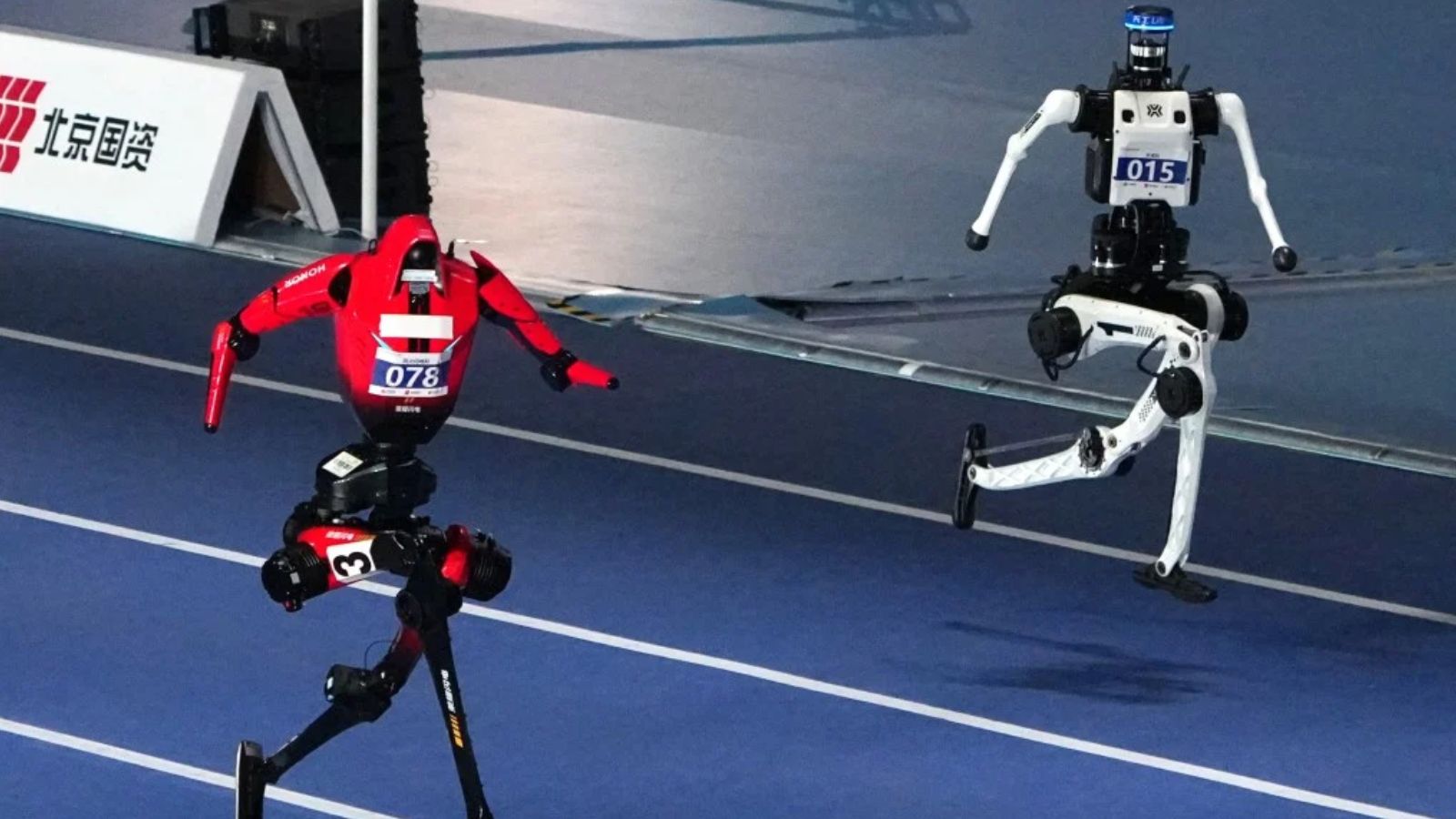
The Tiangong Ultra clocked an astonishing 9.39 seconds at the World Humanoid Robot Games in Beijing, outpacing Bolt’s legendary 9.58-second mark.
A groundbreaking moment unfolded in Beijing as a humanoid robot, named Tiangong Ultra, surpassed Usain Bolt's iconic 100-meter sprint world record. The bipedal machine recorded an astonishing time of 9.39 seconds, eclipsing Bolt's 2009 mark of 9.58 seconds, before concluding its run with a dramatic impact into a barrier.
This historic achievement took place during a preliminary heat at the second World Humanoid Robot Games, an international showcase for advanced robotics. Developed by Beijing-based X-Humanoid, also known as the Beijing Humanoid Robot Innovation Center, Tiangong Ultra's performance captivated onlookers.
While the feat does not alter official human athletic records, it marks a significant milestone in the realm of robotics and artificial intelligence. The unexpected conclusion to the record-breaking sprint adds an intriguing twist to the narrative, according to reporting by Dexerto - Esports & Gaming.
Tiangong Ultra Breaks the 100m Robot Sprint Record
The Tiangong Ultra robot delivered a sensational 9.39-second dash in the 100-meter event, officially becoming the fastest bipedal machine to complete the distance. This remarkable time outpaced Usain Bolt's legendary 9.58-second world record, set at the 2009 World Athletics Championships in Berlin, by 0.19 seconds. Another formidable competitor, Honor's Lightning robot, also finished faster than Bolt, clocking in at 9.47 seconds and trailing Tiangong Ultra only near the finish line. It is crucial to note that these robot achievements, while extraordinary, do not supersede Usain Bolt's official World Athletics record, which exclusively applies to human athletes.
The World Humanoid Robot Games: A Global Showcase
The Second World Humanoid Robot Games in Beijing served as the grand stage for this record-breaking display. Spanning five days, the event brought together an impressive 2,056 robots from 666 teams representing 16 countries. Competitors engaged in a diverse array of 51 events, including 30 distinct sporting competitions and 21 challenges designed around real-world tasks. Beyond the high-speed sprints, robots participated in activities ranging from soccer and table tennis to weightlifting, Tai Chi, factory work simulations, restaurant service, and emergency response tests. The 100-meter sprint, however, garnered significant global attention, as teams vied to develop a machine capable of beating Bolt's time.
A Crash Course in Stopping: The Robots' Dramatic Finish
Despite their unparalleled speed, the humanoid robots encountered a crucial challenge once their sprints concluded: stopping. Both Tiangong Ultra and Honor's Lightning demonstrated an inability to decelerate gracefully, charging directly into a thick, cushioned barrier positioned at the track's end. Tiangong Ultra stumbled noticeably towards the sidelines after impact, while Lightning suffered a more severe outcome, collapsing entirely and requiring manual removal from the track. This post-finish line drama highlighted one area where human athletes, specifically Usain Bolt, still maintain a clear advantage over their mechanical counterparts.
X-Humanoid's Innovation in Humanoid Robot Development
The engineering prowess behind the Tiangong Ultra robot comes from Beijing-based X-Humanoid, officially known as the Beijing Humanoid Robot Innovation Center. Their work underscores the rapid advancements in creating bipedal machines capable of complex athletic maneuvers. While the robots' inability to stop efficiently remains a design hurdle, the core achievement of simulating and exceeding human top sprint speeds signifies a major leap forward in humanoid robot development. This groundbreaking sprint signals the continuous evolution of robotics, pushing the boundaries of what these machines can accomplish in sports and beyond.
Frequently Asked Questions
Did a robot really break Usain Bolt's 100m world record?
Yes, the humanoid robot Tiangong Ultra ran the 100 meters in 9.39 seconds, which is faster than Usain Bolt's human world record of 9.58 seconds.
What is the Tiangong Ultra robot's 100m time?
The Tiangong Ultra robot completed the 100-meter sprint in an impressive 9.39 seconds.
Where did the robot 100m sprint take place?
The record-breaking 100-meter sprint occurred at the Second World Humanoid Robot Games in Beijing, China.
Does this robot record replace Usain Bolt's official world record?
No, this robot's record does not replace Usain Bolt's official World Athletics record, which is exclusively reserved for human competition. Bolt's 9.58-second mark remains the fastest ever recorded by a human athlete.
Who developed the Tiangong Ultra robot?
The Tiangong Ultra robot was developed by Beijing-based X-Humanoid, also known as the Beijing Humanoid Robot Innovation Center.