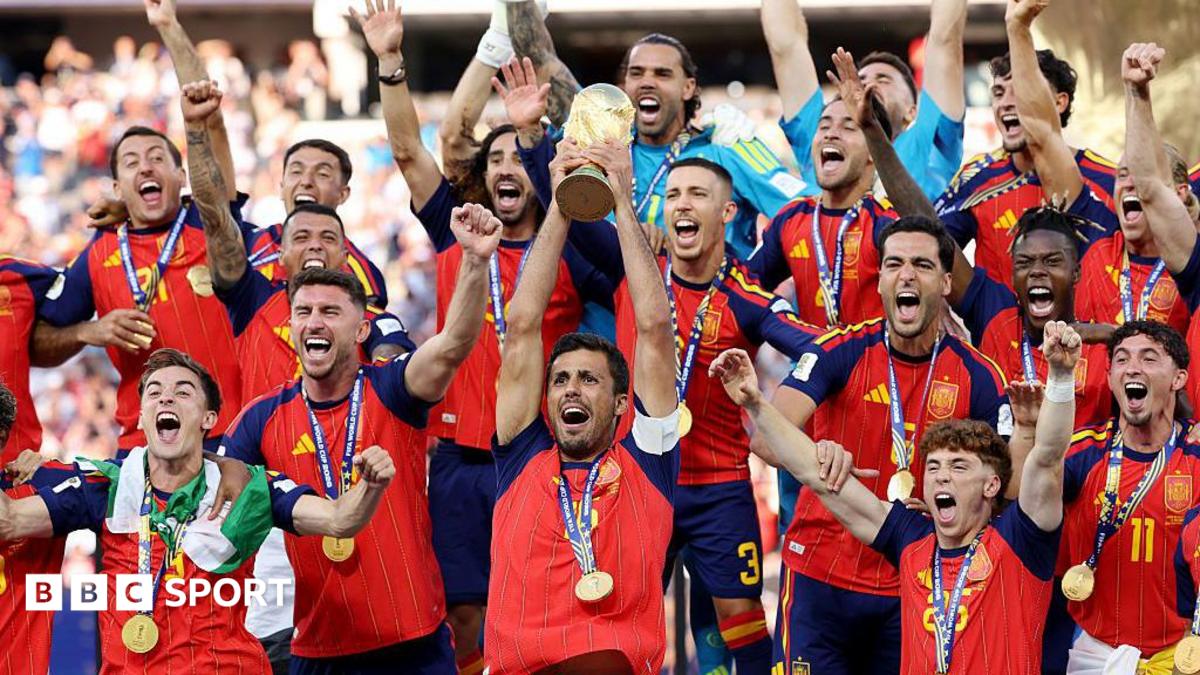
European and North American federations strongly oppose FIFA President Gianni Infantino's controversial plan to sell stakes in tournaments.
European football's governing body, UEFA, and its 55 member associations have collectively voted to boycott all FIFA World Cups. This drastic measure would be triggered if FIFA, the global football overseer, moves forward with its proposal to sell ownership stakes in its major competitions to private investors. The decision underscores a deep division at the highest levels of international football.
This unified opposition emerged from an emergency meeting called to address the contentious plan, which FIFA President Gianni Infantino announced earlier this week. The fallout is significant, as European football holds immense power and influence within the global game.
Adding to the pressure on Infantino, Concacaf, which governs football in North and Central America and hosted this year's World Cup, also announced its 41 member associations have "rejected" the proposal. Sources indicate that Concacaf nations are increasingly losing trust in Infantino's leadership, according to reporting by BBC Sport - World Cup.
FIFA's Controversial Investment Strategy
FIFA's plan involves creating a new commercial subsidiary, named FIFA Forward Enterprise (FFE), specifically to manage its premier events, including the men's and women's World Cups. External investors would then be invited to purchase minority, non-controlling stakes in this new entity. The proposal requires approval from 106 of FIFA's 211 member associations to pass.
Infantino has reportedly offered a significant financial incentive, promising member federations $40 million if they back his controversial proposal. He set a deadline of September 19 for federations to accept his terms to access an initial $20 million payment. In a video defense, Infantino described the plan as an "offer, not an obligation," but critics argue it's a form of coercion.
Should the plan be approved, American venture capital firm Thrive Eternal, founded by Joshua Kushner (brother of Jared Kushner, former US President Donald Trump's son-in-law), is expected to lead the investor group for FFE. Despite her role as one of eight FIFA vice-presidents, FA chairwoman Debbie Hewitt stated she was unaware of Infantino's discussions regarding these proposals.
United Front Against FIFA's World Cup Sell-Off
UEFA had already expressed its strong disapproval through two scathing statements prior to the boycott vote. Its latest statement, issued after a virtual meeting chaired by President Aleksander Ceferin, emphasized that all 55 European member associations "stand as one" in rejecting the transfer of World Cup ownership interests to private investors. UEFA accused FIFA of conceiving such a significant proposal "in secret" and "without any meaningful consultation," calling it a "profound failure of leadership" and an "abdication of FIFA's duty."
The organization further criticized FIFA, stating, "The World Cup cannot be treated as an investment product. It is one of football's greatest sporting legacies." UEFA reiterated its firm stance that "No part of it should ever be surrendered to private investors. The World Cup is not for sale." The boycott would encompass all FIFA competitions, including the Men's World Cup, Women's World Cup, and Club World Cup.
Laura McAllister, UEFA vice-president and former Wales international, described FIFA's proposals as a "genuine existential threat to the game." She highlighted the "real unity" among UEFA members and an "easy consensus over the need to take the strongest possible action given the existential threat." McAllister added that UEFA felt it had "no choice other than to issue a threat commensurate with this dreadful, catastrophic proposal that has been rushed through with no due diligence, no proper governance and no consultation."
Potential Consequences for Global Football
The combined opposition from UEFA and Concacaf accounts for 96 member associations, with 90 of them holding voting rights and appearing set to vote against the proposal. This makes it challenging for Infantino to secure the 106 votes needed for approval. The first major test of this boycott stance at a senior tournament could come as early as October, when the Women's World Cup play-offs are scheduled to take place.
While Europe represents only a quarter of FIFA's total membership, its influence is disproportionate. European nations have won 13 of the 23 World Cups to date, with South American sides winning the remaining 10. Six of the eight quarter-finalists at this summer's World Cup were European, including winners Spain, underscoring the continent's dominance in global football. Both England's Football Association and the Scottish FA have publicly stated their "unequivocal" opposition to the plans.
Frequently Asked Questions
What is FIFA President Gianni Infantino's controversial plan?
FIFA President Gianni Infantino proposes creating a commercial subsidiary, FIFA Forward Enterprise (FFE), to run major events like the World Cups, and then selling minority stakes in FFE to private investors. He has offered $40 million to member federations who support the plan.
Why are UEFA and Concacaf opposing this plan?
UEFA and Concacaf believe the World Cup and other competitions are a sporting legacy, not an investment product, and should not be owned by private entities. They also criticized the lack of consultation and transparency in developing the proposal.
What does the UEFA boycott threat entail?
UEFA's 55 member associations have voted to boycott all FIFA competitions, including the Men's World Cup, Women's World Cup, and Club World Cup, if Infantino's private investment proposals are approved by FIFA's member associations.
What happens if FIFA's plan is not approved?
If Infantino fails to secure the 106 votes needed for approval, the plan to sell stakes in FIFA's competitions to private investors would likely be abandoned or significantly revised, averting the threatened UEFA boycott.
When could the UEFA boycott first be tested?
The first senior tournament where UEFA's boycott stance could be tested is in October, during the scheduled Women's World Cup play-offs, if FIFA's plan has been approved by then.