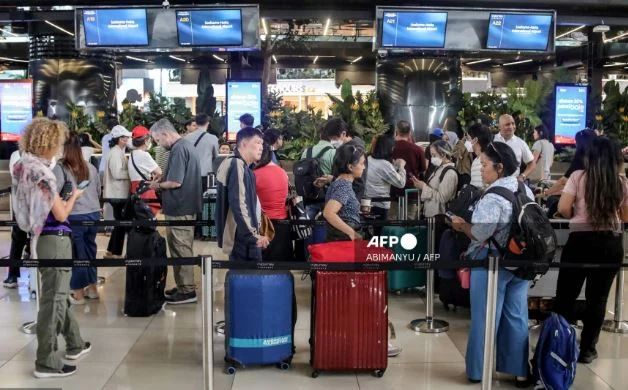
Thousands of travelers are stranded as ash from the Anak Krakatoa volcano forced the closure of Soekarno-Hatta International Airport and several others.
Indonesia's principal international gateway, Soekarno-Hatta International Airport in Jakarta, ceased all operations on Sunday following a volcanic eruption. Ash from the Anak Krakatoa volcano, located over 150 kilometers away, spread into the airspace, leading to widespread flight cancellations and impacting thousands of passengers globally. This unexpected halt has thrown travel plans into disarray, affecting both domestic and international routes, according to reporting by Punch Nigeria - Sports.
The volcanic activity began on Saturday with a powerful eruption that generated a lava fountain and booming sounds audible for hundreds of kilometers. Two additional eruptions were recorded on Sunday, escalating concerns and prompting authorities to extend the initial suspension of airport services. The disruption highlights Indonesia's location on the volatile Pacific Ring of Fire, a zone known for frequent seismic and volcanic events.
Initial flight suspensions from 1:30 AM Sunday (Saturday 6:30 PM GMT) to 5:30 AM were extended multiple times throughout the day, with the latest suspension planned until 5:30 PM Sunday. This decision was made due to “increased eruptive activity,” as stated by the airport via social media. The cascading effect of these closures has left many travelers scrambling to find alternative arrangements, uncertain about when normal operations will resume.
Anak Krakatoa Eruptions Cause Widespread Air Travel Chaos
The Anak Krakatoa volcano, known as the "Child of Krakatoa," sits in the strait separating Java and Sumatra islands. Its recent activity detected ash plumes in critical air corridors, directly impacting air travel. Indonesia’s Transportation Minister Dudy Purwagandhi confirmed that six airports, including Hussein Sastranegara in Bandung and Radin Inten II near Bandar Lampung, have suspended operations. Several other city airports, such as Semarang and Surabaya, have been designated as alternative landing sites for rerouted flights.
The impact on passengers has been significant, with the transportation ministry reporting that more than 22,000 travelers have been affected. A total of 209 flights faced cancellation or delay, with a particular emphasis on routes connecting to and from Singapore. International services to Doha, Sydney, and Kuala Lumpur were also among those impacted, alongside at least 16 domestic flights to and from Bali, adding to the travel complexities.
Travelers Face Delays and Uncertainty Amid Volcanic Ash
Passengers caught in the disruption described a frustrating but understanding situation. Henny Yensan, 44, a businesswoman who hoped to travel to her hometown with her mother, expressed disappointment but noted the general calm. "Everybody was disappointed," Yensan told AFP, adding, "No one flew into a rage, because after all, this is due to a natural disaster." She was forced to reschedule her flight to Tuesday, highlighting the unpredictability of the situation.
Another affected traveler, Samuel Guiberteau, 47, a Danone executive on a business trip to Lombok since Friday, found himself in limbo. Searching for alternative flights back to the capital, Guiberteau told AFP by phone that "nothing is certain for the moment." He discovered that a replacement flight he had booked on Citilink was also canceled, leaving him no option but to extend his stay in Lombok for the time being.
Volcano's History and Current Safety Measures
Anak Krakatoa has been intermittently active since its emergence from the sea in the early 20th century, forming within the caldera left by the catastrophic 1883 eruption of Mount Krakatoa. That historical event was one of the deadliest ever recorded, claiming an estimated 35,000 lives. Authorities are now strictly enforcing an exclusion zone, prohibiting vessels from approaching within a 3-kilometer radius of the volcano to ensure navigation safety in the strait.
Geology agency head Lana Saria explained that "seismic activity indicates the movement or release of volcanic fluids within the volcanic system." However, she cautioned that "the timing, magnitude, and nature of the next eruption cannot be precisely predicted." Saria further assured the public that the current series of eruptions does not possess the potential to trigger a tsunami, a crucial distinction given the 2018 tsunami, which killed 429 people after a partial collapse of Anak Krakatoa.
Frequently Asked Questions
What caused the suspension of Indonesia's main airport operations?
Operations at Soekarno-Hatta International Airport, Indonesia’s main international hub, were suspended due to volcanic ash spewed from the Anak Krakatoa volcano, which drifted into the surrounding airspace.
How many airports and passengers are affected by the Anak Krakatoa eruption?
A total of six airports, including Soekarno-Hatta, have suspended operations. The transportation ministry reported that more than 22,000 passengers and 209 flights have been impacted, particularly on routes to and from Singapore, Doha, Sydney, and Kuala Lumpur.
Is there a tsunami risk from the current Anak Krakatoa volcanic activity?
No, geology agency head Lana Saria confirmed that the current series of eruptions from Anak Krakatoa does not have the potential to trigger a tsunami. This is distinct from the 2018 event, where a partial collapse of the volcano caused a deadly tsunami.
When is Soekarno-Hatta International Airport expected to resume normal operations?
Initial suspensions at Soekarno-Hatta International Airport were extended multiple times on Sunday due to increased eruptive activity. While the latest suspension was set to end at 5:30 PM Sunday, the exact resumption of normal operations remains uncertain and dependent on further volcanic activity.
What is the Pacific Ring of Fire and its connection to Indonesian volcanoes?
The Pacific Ring of Fire is a major area in the basin of the Pacific Ocean where a large number of earthquakes and volcanic eruptions occur. Indonesia, being a Southeast Asian archipelago nation, sits directly on this Ring, making it highly susceptible to frequent volcanic and seismic activity like the Anak Krakatoa eruption.